Home Solar Panel Cost & Honest Payback Math in 2026
In 2026, an 8.4 kW US residential solar array costs $21,500–$27,000 cash. With Section 25D expired (P.L. 119-21), state incentives and 30% 48E TPO leases reshape payback.
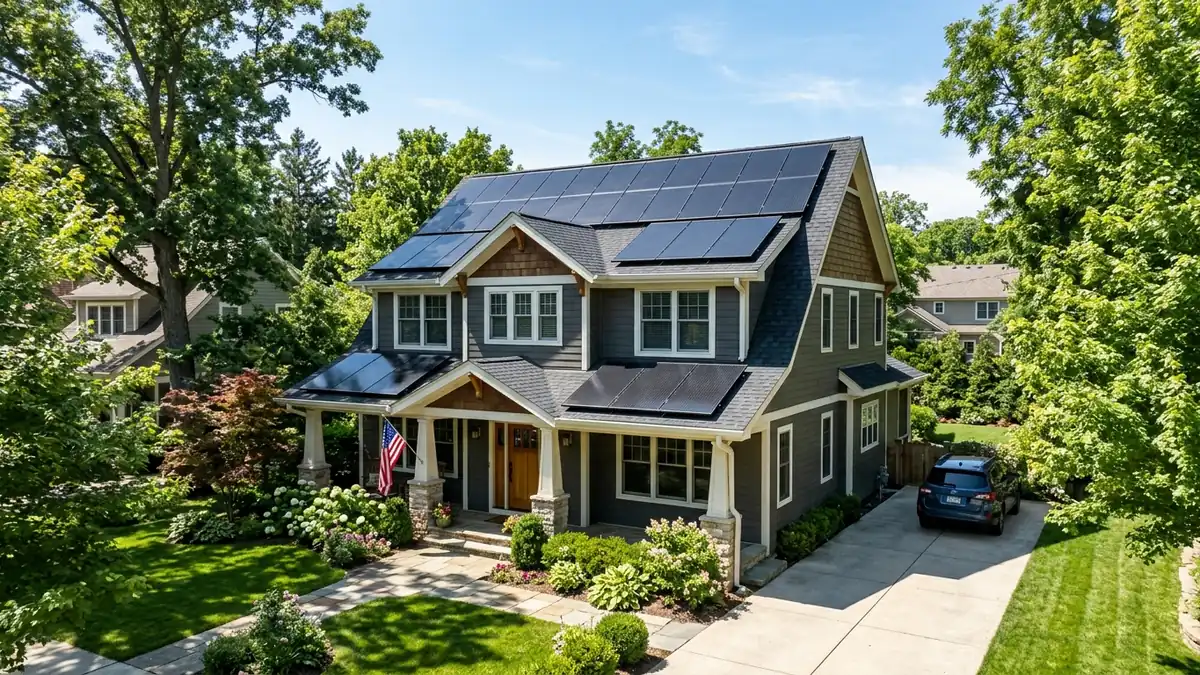
2026 US Residential Solar Purchase Structures Compared (8.4 kW System)
| Purchase Structure | 2026 Federal Tax Credit | Typical Gross / Effective Cost | Key Trade-Off to Verify |
|---|---|---|---|
| Cash / Local Credit Union Loan | 0% (Sec. 25D expired Dec 31, 2025) | $21,840 – $25,620 ($2.60–$3.05/W) | Full ownership, no escalator, lowest long-term cost in high-rate / strong-rebate states |
| TPO Lease / PPA / Prepaid Lease | 30% via Sec. 48E (claimed by system owner) | 15%–25% lower effective upfront / payment | Check annual escalator (0%–2.9%), buyout schedule, and home-sale transfer clause |
| Low-APR Solar Dealer Loan | 0% (Sec. 25D expired) | $30,240 – $36,540 ($3.60–$4.35/W) | 20%–35% hidden lender dealer fee baked into principal |
| Solar + 13.5 kWh LFP Battery (Cash) | 0% federal (check state/utility rebates) | $34,000 – $38,600 | Critical under CA NEM 3.0, TX ERCOT, AZ, and NC TOU tariffs |
The 2026 Federal Tax Split: Section 25D (0%) vs. Section 48E TPO (30%)
Under Public Law 119-21 (OBBBA, enacted July 2025), the homeowner-claimed Section 25D Residential Clean Energy Credit expired on December 31, 2025. Homeowners paying cash or using a personal solar loan in 2026 receive 0% federal tax credit — making competitive cash $/W pricing and state/utility incentives far more decisive than before.
Crucially, commercial third-party-owned (TPO) residential systems — leases, power purchase agreements (PPAs), and prepaid leases — still qualify for the 30% Section 48E Clean Electricity Investment Credit in 2026 when owned by a commercial financier meeting statutory requirements. As a result, a transparent 0%-escalator prepaid lease or well-priced TPO contract with a clean Year-6 buyout option can legitimately beat cash on net present value in states without strong state tax credits.
Never rely on verbal savings claims. Compare total 25-year net cash outflow: (1) Cash quote minus state tax credits/SRECs vs. (2) Prepaid lease upfront payment + Year-6 buyout price, or monthly lease/PPA payments with the exact annual escalator (0% vs 2.9%). Verify who retains SRECs and state rebates in the contract.
Why Cash $/Watt Remains Your Baseline Benchmark
Even when evaluating a TPO lease, always request a pure cash quote divided by total DC watts (for example, $23,520 ÷ 8,400W = $2.80/W) so you can spot inflated system markups. Door-to-door solar loans advertising "4.99% APR" still bury 20%–35% dealer fees into the principal.
In 2026, competitive regional installers using Tier-1 N-type TOPCon 420W–440W modules and Enphase IQ8 or SolarEdge/Tesla inverters quote $2.55–$2.85/W in Texas, Florida, and Arizona, and $2.90–$3.25/W in California, New York, and New England.
Net Metering Matters More Than Sunshine
A homeowner in New Jersey (4.4 peak sun hours, 19.6¢/kWh, 1:1 retail net metering + $85 SREC-II) often beats a homeowner in sunny Arizona (6.4 peak sun hours) on payback speed because exported kilowatt-hours are credited at full retail value instead of wholesale avoided cost.
Under export-rate tariffs like California NEM 3.0 (Net Billing Tariff), Texas ERCOT buyback plans, or Georgia Power instantaneous netting, unstored daytime exports earn only 20%–45% of retail rates. Adding one 13.5 kWh LFP battery raises solar self-consumption from ~35% to 78%–88%, cutting peak evening utility bills sharply.
Top Active State & Utility Incentives in 2026
With Section 25D gone for direct residential purchases, state-level programs dictate where cash solar pencils fastest: DC SRECs ($350–$420/MWh), New York 25% state credit (up to $5,000) + NY-Sun, South Carolina 25% state credit, Illinois Shines upfront SREC rebates, New Jersey SuSI SREC-II, Hawaii 35% state credit, and Duke Energy North Carolina PowerPair battery incentives (up to $9,000).
Sources & Standards Referenced
- IRS Clean Energy Tax Incentives (Sec. 25D & 48E) — Statutory expiration of Sec. 25D after Dec 31, 2025 under P.L. 119-21 and commercial 48E eligibility
- NREL Annual Technology Baseline & PVWatts — Solar irradiance and residential installed cost benchmarks
- U.S. EIA Electric Power Monthly — State-by-state residential retail electricity rates
- DSIRE Database of State Incentives — Active state tax credits, SREC markets, and utility battery programs