200-Amp Electrical Panel Upgrade Cost in 2026: Real Line-Item Breakdown
A 2026 residential 200-amp electrical panel upgrade costs $2,500 to $4,800 for full overhead service and $4,500 to $8,500 when underground trenching is required.
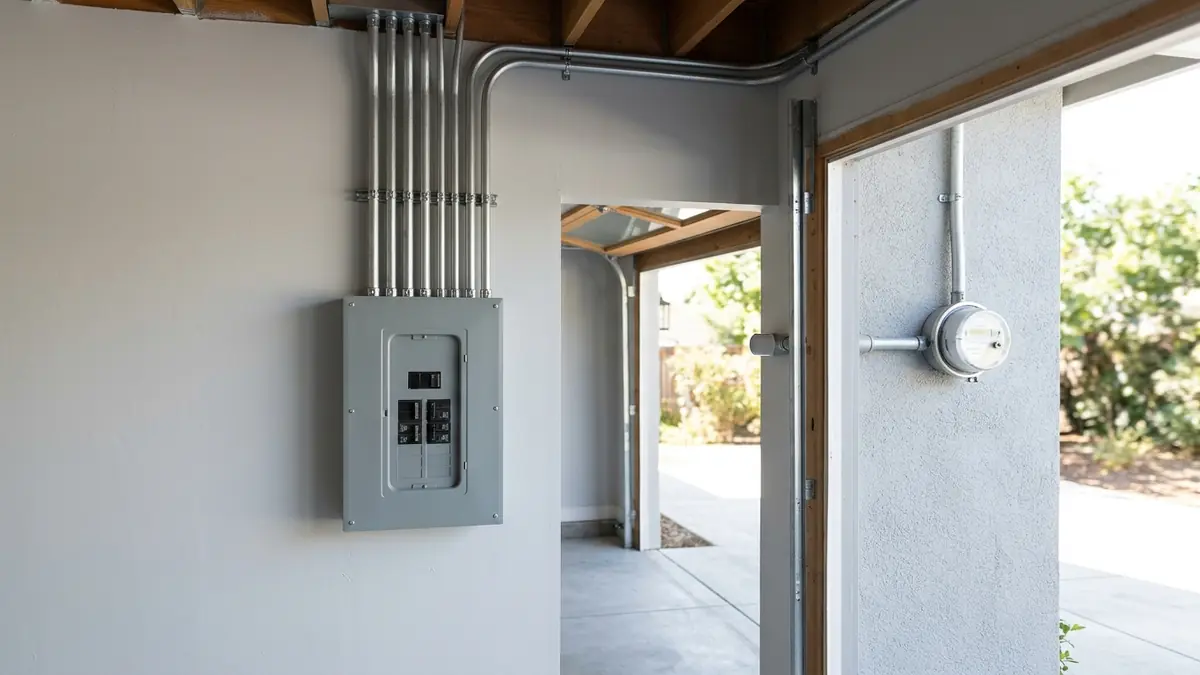
2026 US 200A Service Upgrade Cost Scenarios
| Scope of Work | Typical Cost (USD) | Permit & Utility | Best Fit Scenario |
|---|---|---|---|
| Panel-only swap (existing 200A service conductors) | $1,800 – $3,100 | Local electrical permit | Replacing FPE, Zinsco, or full 20-space box |
| Full 100A → 200A overhead heavy-up (mast, meter base, ground rods) | $2,500 – $4,800 | Permit + utility disconnect/reconnect | Adding Level 2 EV charger, heat pump, or solar |
| 200A upgrade with underground lateral trenching | $4,500 – $8,500 | Utility engineering + trench inspection | Suburban homes with buried 100A service cable |
| Alternative: 100A panel + UL-listed EVEMS load manager | $900 – $1,600 | Permit only (no service upgrade) | Healthy modern 100A panel adding EV charging only |
Where the Money Actually Goes on a 200-Amp Heavy-Up
Homeowners often compare two quotes for the same 200-amp upgrade and see a $2,000 gap. Almost always, the lower bid is swapping only the indoor breaker box ($1,800–$3,100) while leaving a 100A meter socket and undersized 2 AWG service entrance cable in place — which fails inspection as a true 200A upgrade.
A code-compliant full 200A overhead heavy-up ($2,500–$4,800) under NEC 230 and NEC 250 replaces five linked parts: the weatherhead or service entrance conductors (4/0 AWG aluminum or 2/0 copper), a 200A ringless meter socket, an exterior emergency disconnect (mandatory under NEC 2020/2023 in most states), the new 40- or 42-space copper-bus load center, and dual 8-foot copper ground rods bonded to cold water and gas piping.
- Materials (panel, 200A main, 4/0 SER cable, AFCI/GFCI breakers, ground rods): $850 – $1,550.
- Licensed master electrician + apprentice labor (8–12 man-hours): $1,200 – $2,600.
- Municipal electrical permit & inspection fees: $120 – $450 (higher in CA, NY, IL metros).
- Exterior emergency disconnect / meter-main combo (NEC 230.85 requirement): +$350 – $700.
When You Can Skip a 200A Upgrade Legally (NEC 750.30 / 2026 Art. 130)
Before writing a $4,500 check, run a real NEC 220.82 optional load calculation. Many 1,600–2,200 sq ft homes with gas heat and a gas water heater actually pull under 65 calculated amps even with central AC — leaving legitimate headroom on a healthy modern 100A panel.
Under NEC 625.42 and NEC 750.30, an Energy Management System (EVEMS) such as a Wallbox Pulsar Plus with power meter, Emporia Pro Load Management, or a SPAN smart panel dynamically throttles your EV charger when the dryer and AC run together. That lets you stay on 100A safely and legally for $900–$1,600.
Note on code editions: NFPA 70-2026 (NEC 2026) reorganizes branch/feeder load calculations from Article 220 into Article 120 and Energy Management Systems from Article 750 into Article 130 — verify which NEC cycle your local AHJ enforces. On incentives, federal Section 25C expired Dec 31, 2025; in 2026, panel discounts come from state HEAR rebates (up to $4,000 for income-qualified homes) and utility electrification programs.
Pro Tip: Ask for a 225A Solar-Ready Busbar
If you plan to install rooftop solar within the next decade, ask your electrician to install a 225-amp rated busbar with a 200-amp main breaker instead of a standard 200A/200A panel. The hardware delta is typically under $140.
Under the NEC 705.12 120% busbar rule, a standard 200A busbar with a 200A main caps your load-side solar breaker at 40A (roughly 7.6 kW AC inverter). Stepping up to a 225A busbar increases that limit to 70A (over 13 kW AC) without needing a costly supply-side tap.
Sources & Standards Referenced
- NFPA 70 (National Electrical Code 2023 & 2026) — Articles 220/120 load calculations, 230 service disconnects, 705.12 busbar rule, 750/130 EMS
- U.S. DOE Home Energy Rebates (HEAR) — State rollout status for up to $4,000 income-qualified electrical panel rebates
- DSIRE State & Utility Incentive Database — Local utility panel upgrade and electrification incentives